
Singapore: the race the briefing described, decided by half a second at a pit entry
Verstappen won from pole on the one-stop we planned, soft to medium on lap 32, and nobody passed him. Ferrari split its strategies and the split cost Hamilton a podium twice over: a medium first stint that was slower than the soft, and a missed pit entry under the lap-38 Virtual Safety Car. Leclerc and Antonelli took the cheap stop and finished second and third. Russell went from P19 to P9 and lost the same lottery by half a second.

The plan held. Soft to medium, one stop around lap 28–34: Verstappen stopped on lap 32, Norris on 32, Lawson on 31, and they finished first, fourth and seventh with nobody passing them. Pirelli's post-race note says the same thing in their words: the one-stop was the most competitive regardless of the neutralisations, soft–medium the most effective, the hard not strategically attractive and chosen by nobody. Our tyre light turned to soft from lap 32; the race leader's stop was on lap 32.
What we did not plan was the second stop, because nobody plans a stop that costs 24 s and then gets it for a fraction of that. The lap-38 VSC turned Ferrari's and Mercedes' flexible hand into a two-stop, soft–medium–soft, with the last 23 laps on new rubber. Leclerc gained 12 s on Verstappen over those laps and finished 7.3 behind; it was never going to be enough against a leader who had stopped once and lost nothing, but it was enough for second and for Antonelli's third. The decision table we published – medium first keeps the stop in hand for the Safety Car, soft first wins the start and the restarts – was right in shape and wrong in one detail: it was a VSC, not a Safety Car, and a VSC does not bunch the field, so the car that stopped under it kept its gap and the car that did not kept its position. That is why both strategies finished on the podium.

The numbers, now from the library's regression over 587 clean soft laps and 428 medium laps: soft 0.041 s per lap of age, medium 0.037 (both ±0.005). Our live regression during the race said 0.040 and 0.037. Equal within noise, which is the 2026 finding Ruth Buscombe published before the weekend and which we adopted. The soft was 0.3–0.4 s per lap quicker in race trim, as expected on a 32 °C track, and that is why Hamilton's medium first stint went backwards and why Hadjar and Bottas, both medium starters, called it the wrong tyre afterwards. Pirelli: the C4 showed virtually no degradation but offered no advantage; the C5 was the star.
Where we were wrong is the level. We planned with 0.02 for both compounds from the 2025 night race and the cool-track argument; the measured rate was twice that. Over a 30-lap stint that is 18 s instead of 9, and over Hamilton's 44 laps on one soft it is the cliff he hit with ten laps to go, losing three places on the last four laps. Pirelli's own description – "drivers who used it for around half the race only experienced a drop-off in the closing stages" – is the mild version of the same curve. The lesson for the library: Marina Bay 2026 goes in at 0.04, and the temperature term should not be allowed to pull a night race below the season's floor.
The hard was not used by anyone, which closes the question of Verstappen's missing new hard from FP1: it cost nothing.

No reports of power loss in the 250 kW sectors, through two VSC periods and a formation lap. The Sepang configuration held; the Austin wet update remains untested in anger. Leclerc ran within the 1.0 s detection window for the first six laps and had Overtake Mode available on every main straight – and could not use it, which is the clearest measurement of this circuit's overtaking threshold we have: a Ferrari within 0.6 s with an extra 150 kW to 310 km/h still needs a mistake ahead. Verstappen's radio failed mid-race; Red Bull ran the last 20 laps on the pit board. Sainz reported a battery problem in the opening laps that cost him two places from a P10 start; Lindblad "power unit consistency issues". Russell's power unit, the one with six fresh elements and a 60-place bill, ran 62 laps without a word.

Mercedes answered our open question: Antonelli raced the new package and the team says it was clearly the faster of the two by Sunday, after a Friday in which it was 0.57 s slower. Russell kept the old wing. Both Mercedes passed cars on track in the closing laps, which the old package could not do at Sepang. Hadjar's car took its eighth engine, seventh turbo and seventh exhaust before the race, all over the season's allowance of four, and then went from the pit lane to tenth. Antonelli reported fluid around his feet and brake concerns from lap 33; Mercedes called it heat soak. Albon managed overheating brakes and a fuel issue for 50 laps before Williams parked the car. Norris: the car is "clearly the fourth fastest at the moment".

Our Saturday-evening forecast said 53 % at the start and no rain; Sunday morning's said 39 % and no rain through 22:00; the race was dry, air 27 °C, track in the low thirties. The 18:00 shower we had flagged as the one scenario that would have made the briefing irrelevant did not come. No corrections to make, one note for the file: the convective probability in the afternoon rows ran to 100 % with a tenth of a millimetre attached – the probability column from this model is a warning, the millimetre column is the forecast.

Pit loss measured at 24.4 s under green, against the 25.9 we planned with; our planner's estimate for a VSC stop was 5.6 s, and the race turned on that difference. (The library's own VSC measurement from this race, 27.5 s over four stops, is contaminated by the stop that straddled the end of the VSC – Russell's – and we do not use it.) Three cars stopped from the top ten during the lap-38 VSC: Leclerc, Antonelli and Perez; Russell entered as it ended and paid most of the full price. Overtaking: Antonelli passed Norris and Hamilton, Norris and Piastri passed Hamilton, Russell passed Ocon and Gasly, Hadjar came through the field – every one of them with a tyre advantage of 20 laps or more, or against a car on the cliff. Hülkenberg held Russell for the last ten laps on older tyres, which is the threshold working as advertised. Two VSCs, no Safety Car, no red flag; Singapore has now gone three races without a Safety Car after fifteen in a row with one.
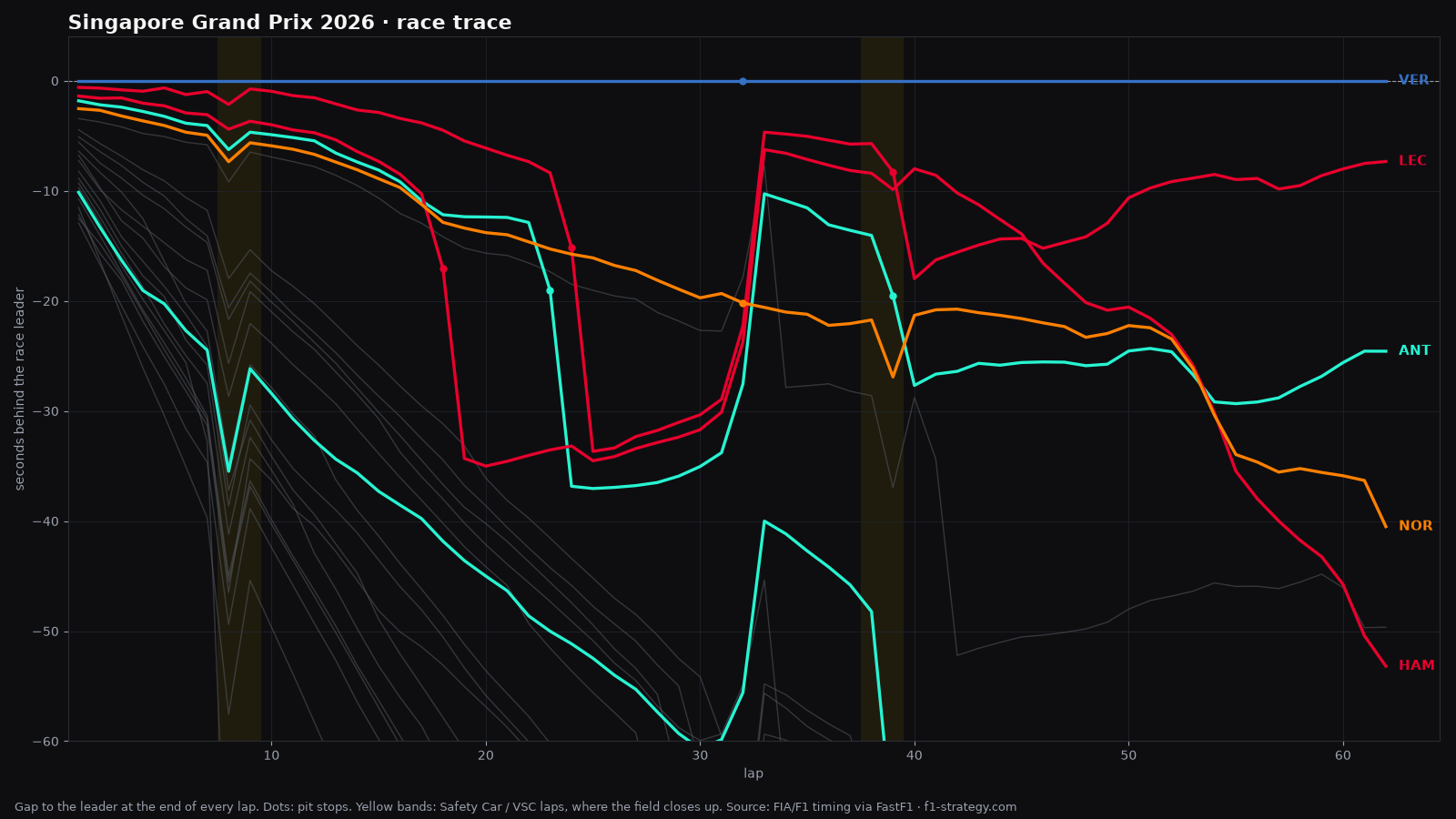

Red Bull did the simple thing: soft, medium, lap 32, and a start that held Leclerc off into Turn 1 after Mekies admitted the start was "an area where we still have work to do". Ferrari split the strategies from P2 and P3 – Leclerc soft, Hamilton new medium – to keep both the one-stop and the two-stop open against Verstappen. Vasseur's own account: the soft turned out stronger than expected against the medium, so Hamilton had the difficult first stint; under the VSC both cars were called in from P2 and P3, Hamilton missed the entry, "and that probably cost him the opportunity to fight for the podium". Hamilton's, on the radio at the flag: "My call, and I lost us valuable points" – the medium was his choice, staying out after the missed entry was his choice, and the last laps were "struggling massively with degradation". Both are right. The medium call was defensible on the information available – Pirelli's note says the C4 barely degraded – and wrong on the pace; the missed entry was the race.
Mercedes took the cheap stop with Antonelli, gave up a place to Norris and took it back with a tyre advantage, then took Hamilton on the cliff: third, and a championship lead of 102. McLaren's two cars ran the two shapes of the race – Norris one stop, Piastri two after a slow puncture on lap 41 – and finished fourth and fifth, with Norris offering on the radio to back Hamilton into Piastri. Stella's statement about the Sprint collision is the longest paragraph any team principal wrote this weekend.

Russell, P19 to P9, one stop: from the back to the fringe of the points by lap 22 on the opening soft, passed Ocon and Gasly on track, stopped a half-second too late to get the VSC rate, and spent the last ten laps behind Hülkenberg. Our target model gave a one-stop on the field's strategy about a two-in-three chance of points from the back; it delivered two points. The number that mattered was the one we said was not in the model – how many cars he could pass before the neutralisation – and the answer was seven. Hadjar, pit lane to tenth, medium then soft, "the soft was much better than the medium, like Baku". Hülkenberg's eighth on a medium opening stint and a defence against a faster Mercedes was the midfield drive of the race. Lindblad lost the race at Turn 1, pinched by two cars.

Ninety-two FIA documents for the round. Decisions that touched the result: none in the race. Hamilton investigated for leaving the track while defending from Norris, no further action; Antonelli black-and-white flag for track limits at Turn 2, no penalty; Sainz noted on lap 1, no investigation. Before the start: Hadjar, Alonso and Stroll to the pit lane for parc fermé changes, Russell's penalty grew from 40 to 60 places with the fourth energy store and control electronics, and the grid became Verstappen, Leclerc, Hamilton, Antonelli, Norris, Piastri, Gasly, Lawson, Lindblad, Hülkenberg … Russell 19th. Hülkenberg was cleared of impeding Sainz in Q1 on the ground that the impeding was not "unnecessary". Three retirements, all mechanical: Bortoleto (gearbox, then a fire in the pit lane), Colapinto (driveline, a second DNF in two days), Stroll (clutch).

The degradation level: 0.02 planned, 0.04 measured, for both compounds. The start tyres: we expected soft for nearly everyone and the grid was evenly split, which means half the field read the medium the way Hamilton did. The Safety Car: we built the decision around one and got two VSCs, which reward the same choice for a different reason. And our live timing: it filed the first stint of half the field as soft because the compound had not been published yet, and logged the chequered flag as a red flag. Both are fixed in the recorder before Austin.

One stop, soft to medium, stop around lap 28–34: the winner stopped on 32. The hard as the worst tyre on a cool night: nobody used it. The tyre light to soft from lap 32: adopted from Ruth Buscombe, and the leader's stop landed on it. The start: pole led lap 1 for the fifteenth dry Singapore race in a row, and Leclerc on the dirty side could not make the move. Russell: points from the back, roughly on the odds. And the one thing we said would decide it – who still had a stop in hand when the neutralisation came – decided it.

Whether Hamilton would have finished on the podium with a VSC stop on lap 38. Our model says a new soft for 24 laps against Antonelli's new soft for 23 is a straight race from 10 s behind Leclerc with Norris and Antonelli close; a podium was possible, second was not. Whether Ferrari's medium call was wrong on Saturday night or only on Sunday evening: Pirelli's data said the C4 would not degrade and it did not; it was simply slower, and the race-trim gap only existed once cars ran in race trim. And whether Red Bull's five new softs mattered: they used two. The spare was insurance against a race that did not happen.
Simulate
Change one driver's pit stops and let everyone else run exactly as they did. The altered driver is modelled with his own pace per compound from the race, degradation, fuel, traffic and the VSC discount – cars that get stuck behind him lose time.