
Sepang: the tyre that faded on Friday won on Sunday
Verstappen won from pole through rain, a red flag, a standing restart on a half-dry track and two Safety Cars. Hamilton drove 31 laps on the soft he gambled on at the restart and climbed from a minute behind to the podium. Hadjar lost third to a flat battery two laps from home. And the wear numbers we built the weekend on turned upside down the moment the track cooled by 22 degrees. Our pit wall, department by department, on what it said before the race and what actually happened.

We said soft, hard, hard. The race said inter, soft, soft. Both can be true, because they were answers to different questions, and the question changed at 15:00 when the rain came.
The dry plan assumed Friday's wear and a 56 °C track. On Sunday morning, when the start was delayed, we wrote that in a wet race the mandatory stop disappears, that the inter-to-slick crossover would decide the first act, and that a cool, rinsed track would make the soft more useful, not less. That held. What we did not do was follow the thought to its end: if the soft is the best tyre on a cool track, the hard is the worst, and "two new hards for everyone" stops being an asset. The teams that finished on the hard, Lawson and the McLarens for a stint, went backwards against the soft runners.
The winning sequence was decided at the first Safety Car. Bottas spun on lap 8, the Safety Car came on lap 9, and everyone who had started on intermediates came in for slicks at half price. Red Bull chose the soft for Verstappen, Mercedes the medium for both cars. From the lap-13 restart to lap 30 Verstappen's clean laps had a median of 1:41.5 against Antonelli's 1:41.9 and Russell's 1:42.5. Half a second a lap for eighteen laps is the race.

The table that explains the weekend, time lost per lap of tyre age, in seconds:
| Friday FP2, track 56 °C | Sunday race, track 34 °C | |
|---|---|---|
| Soft C4 | 0.27 (144 laps, R² 0.92) | 0.03 |
| Medium C3 | 0.29 (106 laps, R² 0.96) | 0.04 |
| Hard C2 | not run | 0.10 |
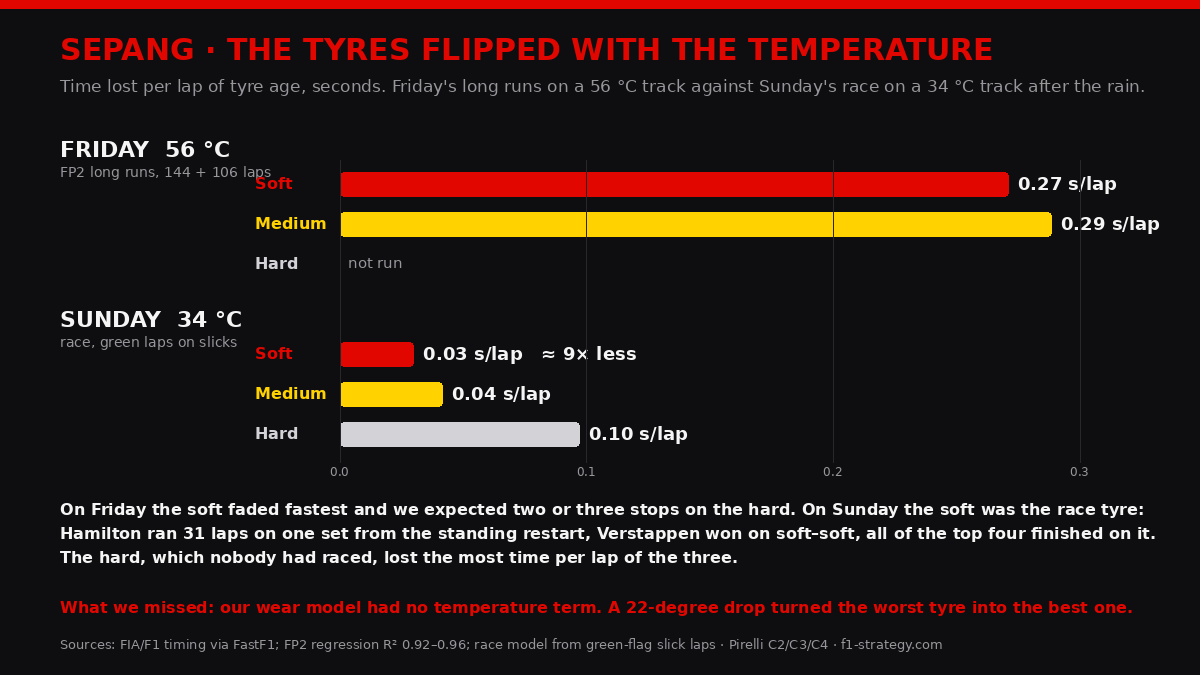
On Friday we measured the highest wear of the season and said nobody would run a soft for long. On Sunday Hamilton ran 31 laps on one set, the top four all finished on it, and Pirelli's own note afterwards says the same thing in their words: lower temperatures and a damp track kept thermal degradation in check, and the soft became the tyre to have. The hard, which nobody had raced before Sunday, lost the most time per lap of the three, with the caveat that it is estimated from fewer laps and the spread is wider.
The lesson is not that Friday's numbers were wrong. They were right for a 56-degree track. The lesson is that our model has no temperature in it, and that a 22-degree drop is enough to reorder the compounds.
A harder admission belongs here too. The site's own forecast, which discounts Friday's raw slope against the season's race data for this kind of circuit, said 0.034 for the soft and 0.036 for the medium, close to what the race delivered. We chose to publish Friday's raw numbers instead, because 144 laps with an R² of 0.92 looked too good to discount. The planner was more right than the people writing about it. Since Monday the planner takes a race-day track temperature and scales wear by a term fitted on the 2026 season, about 1.3× per 10 °C, a first estimate from 35 compound-race pairs that will firm up as the season goes on.
On the tyre count: we estimated two new hards for Verstappen before the race. Ruth Buscombe, working from what we believe was Pirelli's official list, had Verstappen and Leclerc on one new hard each. It did not matter on Sunday, but we will take Pirelli's "tyres available" list as the source from Singapore on and treat our timing-data count as the fallback.

The battery decided a podium, just not the way we expected. We wrote that the car behind gets 9.0 MJ into Turn 1 and that this would favour the attacker. It did, for Hamilton and Leclerc in the final four laps. But the driver who lost out was Hadjar, who reported having no battery for the first two laps after the lap-52 restart, could not defend on the straights, and dropped from third to fifth. Hadjar's median over the last four green laps was 1:40.2 against Verstappen's 1:38.5 and Hamilton's 1:39.3; before the Safety Car the gap between the two Red Bulls had been a second a lap, not two. Red Bull say they will look at the data. So will we, when the telemetry is published.
The other energy story is Russell's: a power unit failure on lap 50 while running third, which turned the VSC into a full Safety Car and bunched the field for the finish.
The bug that stopped the start
The first start never happened because several cars could not accelerate behind the Safety Car. The FIA's Nikolas Tombazis confirmed a software problem in the energy-management control that all teams run, triggered by very low speed, the wet-weather energy settings and Sepang's sector configuration, and fixed by removing the power limit in the affected mini-sectors and sending a new software version to every team, about twenty minutes of work before installation. That much is confirmed. The detailed chain published since, that the 250 kW sectors, a turbo without boost at low revs and an anti-manipulation protection called continuous offset combined into a loop the car could not leave, is a reconstruction that the FIA has not yet confirmed in full, and we treat it as the leading hypothesis, not a finding.
What we can add is the timing data, because our recorder was running. The car telemetry in the timing stream, sampled a few times a second, shows the pattern directly. Verstappen is the first: from 15:41:45 local time the throttle pedal is at 100 % while the car does 35 km/h at 3,800 rpm, and it stays that way for nine seconds of samples. Hamilton follows at 15:42:11, 31 km/h at 3,700 rpm with the pedal flat, in bursts totalling 24 seconds over two minutes. Bortoleto, Bearman and Ocon are the worst affected, 85 to 110 seconds each of full throttle below 45 km/h. Hülkenberg, Bottas, Norris, Piastri, Lindblad and Pérez show shorter episodes. Six cars show none at all: both Mercedes, Hadjar, Alonso, Stroll and Lawson. That spread fits Tombazis's explanation that speed, not engine supplier, decided who was caught: the concertina behind the Safety Car put different cars through the same sectors at different speeds.
The sectors themselves were in the FIA's power unit document for this round, which we published on Thursday: 250 kW instead of 350 kW in the stretches from Turn 4 to Turn 7 and from Turn 9 to Turn 14. Turn 9 is where the first reports placed the problem. The red flag came at 15:45:11 by the timing stream, nine and a half minutes after the cars left the grid.
Update, 8 October. The FIA has published its review. Its finding is that some cars running at low engine rpm in the sectors where the 250 kW reduction applied lost more power than intended and could not recover it inside those sectors. The FIA's own timeline matches our recorder: suspension at 15:45, cause identified and a corrected software configuration released by 15:50, further guidance at 16:03, integration complete by 16:20, the ten-minute signal at 16:22 and cars out of the pit lane at 16:33. The FIA also says the wet-weather package had been simulated by the teams and run in full in FP1 at Spa and Zandvoort. The Sepang configuration will be used again in Singapore if similar weather is expected, and a further update to the wet-weather software comes for Austin. Our reading of the traces stands: speed, not engine supplier, decided who was caught.
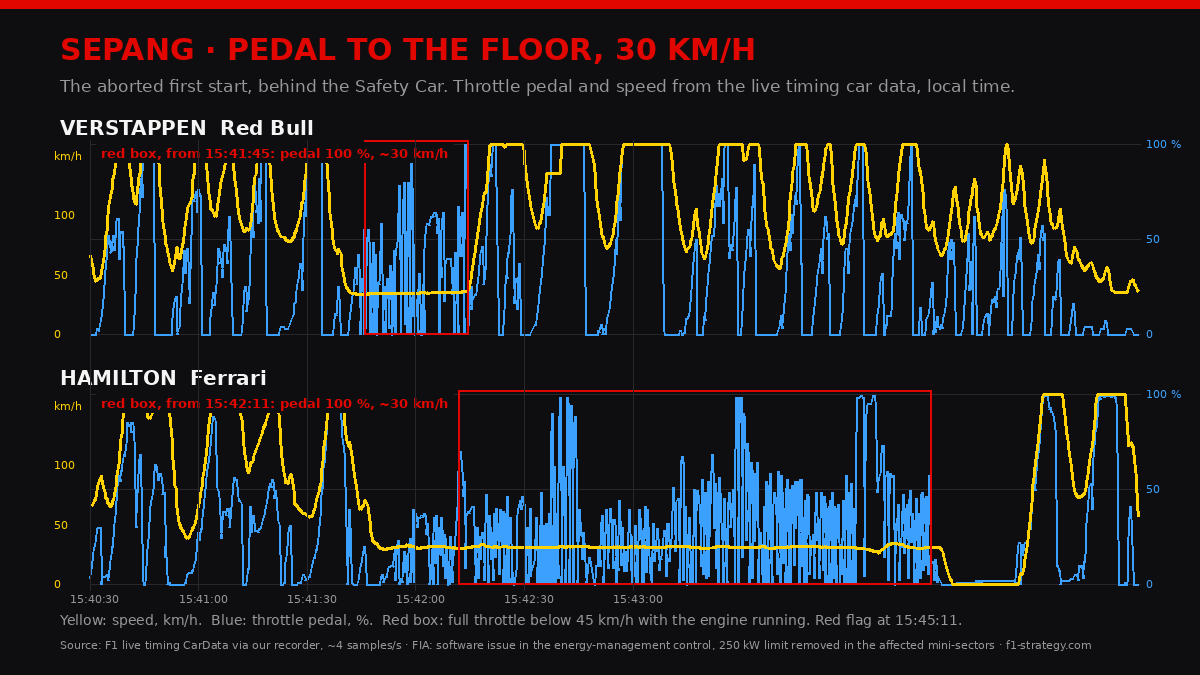 Verstappen and Hamilton during the aborted start. Yellow: speed. Blue: throttle pedal. Red box: full throttle below 45 km/h with the engine running. Source: F1 live timing CarData via our recorder.

Mercedes brought seven new parts, the most of anyone, and called it their worst weekend of the season. The upgrade effect we track across the year says large packages gain about 0.16 % of lap time relative to the field on average, with a spread four times that; Sepang goes in as one of the misses, and we will see in Singapore whether it is the parts or the set-up. Red Bull's one part and a car that was quick at both ends of the lap on Saturday did the job on Sunday. McLaren, slowest on the straights in qualifying, were by their own account the fourth-fastest package all weekend; Norris and Piastri finished ninth and sixth.

The forecasts gave 50 % at 15:00 and the cell arrived at 14:00. The circuit's own station, which we read from the timing stream every minute, had no rainfall flag after 15:40, track temperature flat at 34 °C and the pressure falling 0.7 hPa in twenty minutes just before the restart, faster than the normal afternoon curve, which is the one sign we had been told to watch. Nothing followed it. The cell that stopped the start emptied itself, exactly the Sepang pattern, and the race was run on a track that was wet from before, not from above. Next time we publish the station readings live rather than reading them for ourselves.

The crossover happened for free. The field's median lap on laps 3 to 8, on a grid split between inters and slicks, sat at 113–116 % of a dry lap, which is exactly the zone where the historical Sepang races say "not yet". Then the Safety Car came and the slick stop cost 9.5 s instead of 23.7, and by lap 15 the median was at 104 %. Nobody had to make the two-lap call, because the Safety Car made it for them. The drivers who had taken slicks at the standing restart paid the full price instead: Hamilton was 62 s behind the leader at the end of lap 2 and 83 s behind at lap 8.
Pit loss measured in the race: 23.7 s under green, 11.8 under VSC, 9.5 under the Safety Car. Thirteen laps neutralised out of 55, all in two blocks.

Ferrari and Mercedes made opposite calls at the grid and both paid, in different currencies. Ferrari put both cars on softs for a standing start on a wet track and lost a minute. Mercedes put both on inters, led the first eight laps, and then fitted the medium under the Safety Car and lost the race to Verstappen's soft. Of the two, Mercedes' was the smaller error and the more expensive one.
Hamilton's recovery was built on the tyre that was supposed to be impossible. He stayed out when Leclerc, Bortoleto and Hülkenberg came in for inters, took the Safety Car gift on lap 9 without stopping, and was twelve seconds behind the leader at the restart in twelfth place. From there his soft, by then thirteen laps old, matched the Mercedes mediums for the next thirty laps: a median of 1:42.4 from laps 13 to 30 against Russell's 1:42.5. Two stops to everyone else's three or four.
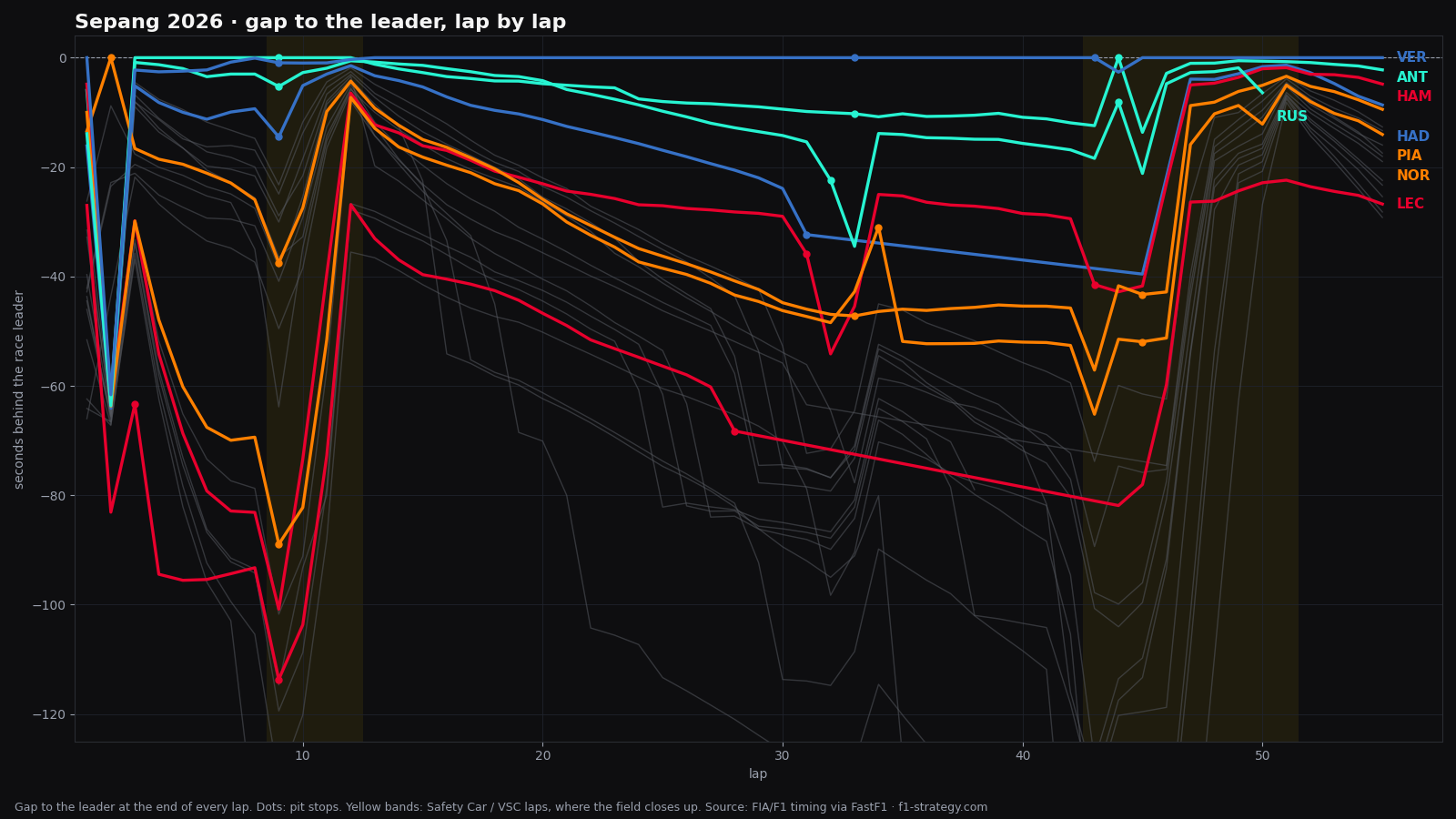 Gap to the leader at the end of every lap. Hamilton (dark red) from 83 s down on lap 8 to 12 s after the first Safety Car, then a steady climb; Hadjar (blue) losing the thread after the final restart. Dots are pit stops, yellow bands Safety Car and VSC laps.
Leclerc's two new softs, which we flagged on Saturday as his flexible card, were spent on a lap-1 collision with Hülkenberg and a front-wing change; he still came back from last to fourth.
McLaren's medium start was the third gamble on the grid and the one with the least upside. Piastri abandoned it after one lap and finished sixth; Norris held it to the Safety Car and finished ninth after running into the gravel behind the Safety Car on lap 51. Aston Martin took two hard stints and fresh softs for the end and scored their best result of the year with Alonso eighth. Racing Bulls, best of the rest with Lawson seventh and Lindblad tenth from the back row, got there on a plain inter, hard, hard, soft.

We circled Hadjar on Saturday and he was third with four laps to go. The last two laps took it away, and the explanation is in the energy section, not in the driver. Verstappen's first win of 2026 came from pole with the fastest median on every stint he ran; pole has now won 11 of 16 races this year. Antonelli, second, leaves with an 84-point lead after Russell's retirement, and a weekend where the race pace that leads our form table was not there.

The race was 55 laps, not 56, after the aborted first start consumed one. The suspended start, the red flag and the delay to 16:33 left just under two hours of racing time, which was enough for the full distance by a few minutes. Norris was reprimanded for driving erratically behind the Safety Car; Bortoleto took ten seconds for the contact with Sainz. Pérez pitted seven times. The FIA's documents page for the event stopped answering our fetches on Sunday; we will collect Sunday's decisions by hand.

Our wear model had no temperature term, so every dry plan was a hot-track plan. We counted two new hards for Verstappen where the official list, we believe, had one. We said 56 laps when the race was 55. Our live pit wall, in its first wet race, flagged every lap of the red-flag period as a pit stop, reset the flag status to green on a sector-clear message during the VSC, and lost its recorder silently during the suspension; all three were fixed during the race and were fixed during the race. And we wrote that the straight-line order would be decided by battery choice; it was, for Hadjar, in the wrong direction.

That a wet race removes the mandatory stop and makes the crossover the first act. That the cool track would make Leclerc's and Verstappen's softs more valuable, not less. That a Safety Car halves the price of a stop and rewards whoever still has one to make, which is how Verstappen got his softs and Hamilton kept his position. That Hadjar was the driver to watch from P8. And that Ferrari's qualifying picture, exposed into Turn 1, was a choice rather than a property of the car: on Sunday both Ferraris passed a Red Bull on the straights.

Why a limit on electrical power made the combustion engine feel disconnected too; the FIA's review confirms low rpm inside the 250 kW sectors as the trigger, but the detailed chain of turbo, offset and loop is still a reconstruction, and our pedal-and-speed traces show the symptom, not the cause. Whether Hadjar's battery was a setting, a fault or a consequence of the restart procedure; the telemetry will tell. How much of Hamilton's soft life was the tyre and how much the cool track; we have one data point. And what the hard would have done on a 56-degree Sunday, which is the race we planned for and never saw.
Simulate
Change one driver's pit stops and let everyone else run exactly as they did. The altered driver is modelled with his own pace per compound from the race, degradation, fuel, traffic and the VSC discount – cars that get stuck behind him lose time.