
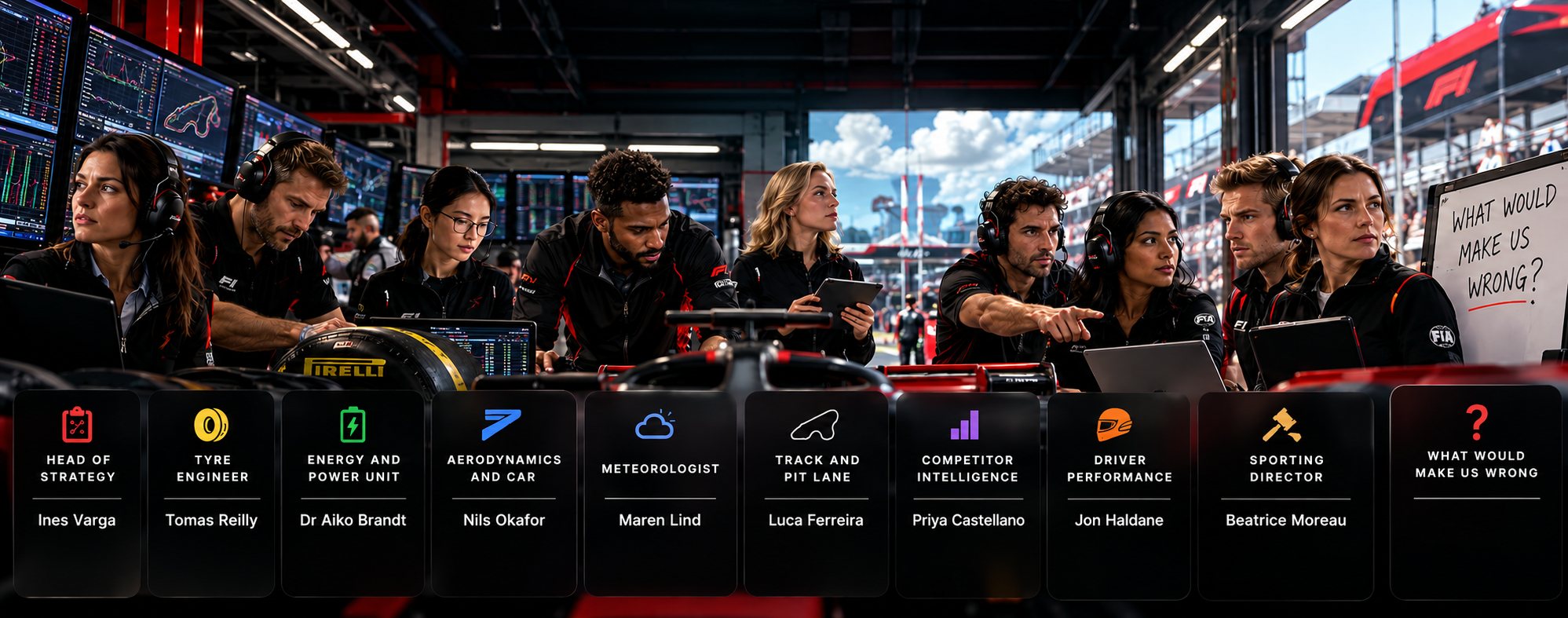
Sepang briefing: two stops, one battery, and a sky that may open
Verstappen on pole by three tenths, eight cars within 0.74 s, tyres that faded faster than anywhere this year, a 7.5 MJ qualifying budget that grows to 8.5 on Sunday, and a 50 % chance of rain at 15:00. Our pit wall, department by department, on what we expect and what would change our mind.

The plan on the whiteboard is soft, hard, hard. Two stops, first around lap 14, second around lap 35, pit loss 23.7 s. With Friday's wear a one-stop costs about 44 s and three stops gains a second on paper, which is inside our error and buys one more rejoin into traffic. Every car has two new hards except Leclerc, so this plan is open to the whole top ten.
Two things flip it. If the hard behaves like Leclerc's five FP3 laps suggested, wear 0.05 instead of the 0.18 we assume, the first stop moves forward to lap 5–8 and the softs become a short opening stint, nothing more. And a Safety Car makes any stop almost free: whoever still has a stop to make when it comes out gains, whoever has just stopped loses. Baku taught us that lesson twice.

Pirelli brought C2, C3 and C4, the same step as Shanghai. Friday's long runs were the worst wear we have measured in 2026: soft 0.27 s per lap of age, medium 0.29, from 144 and 106 clean laps with R² above 0.9. The longest clean stint anyone managed was 13 laps. The medium was 0.07 s/lap quicker than the soft on the same fuel, which is why we expect no one to want a long soft stint.
The hard is the unknown. Nobody ran it on Friday; Leclerc's five laps in FP3 showed a slope near 0.03, far better than the others, on a cool track and a short run. We have assumed 0.18 for the plan and 0.05 for the optimistic case.
What is left in the garages, by our count from the timing data: everyone has two new hards except Leclerc (one new, one with five laps). Hamilton, Leclerc and Bortoleto have no new medium. Six of the top eight have no new soft; Verstappen and Hamilton have one, Leclerc two. Pirelli's official list may differ slightly.

Qualifying ran on 7.5 MJ per lap of recharge, 1.5 MJ less than Shanghai's 9.0, and the lap has more straight than that pays for. The breakdown published by @RedLightsOff5 shows where each battery ran dry: Norris on 9 % of the lap, Piastri 7, Hamilton 6, Antonelli 5, Russell and Leclerc under 5. McLaren spent early and arrived empty, which explains 268–269 km/h across the line better than wing level does.
Sunday's budget is 8.5 MJ, 9.0 for a car within the detection point at 5110 m, with the extra power released at 5160 m, just after Turn 15 and onto the main straight. Less clipping for everyone, and the car behind has the bigger battery exactly where passing happens: into Turn 1. The 250 kW sectors (T4–T7, T9–T14) and four Straight Mode zones are in the FIA PU document for this round.

Fourteen new parts across six teams for this round, from the FIA submissions: Mercedes seven, Racing Bulls two, McLaren, Red Bull, Ferrari, Haas and Alpine one each; Williams, Aston Martin, Audi and Cadillac nothing. Of those, McLaren's and Alpine's are cooling, Haas's is reliability. A heat hazard was declared for the weekend, and Sepang in October is where cooling margins get spent.
Qualifying speeds, one lap each: across the finish line Mercedes 280, Verstappen 279, Red Bull's Hadjar 277, Ferrari 273–274, McLaren 268–269. At the speed trap on the back straight Hamilton 316, Piastri 314, Norris 312, Hadjar and Leclerc 311, Verstappen 310, Russell 309, Antonelli 306. The midfield ran lower wings: 320–329 at the trap. Part of that order is battery choice, not drag, see the energy section.

Track temperature in qualifying was 56 °C. The latest forecasts we have seen give around 50 % for rain at the 15:00 start, after a Saturday morning that threatened 70 % and stayed dry. Sepang storms arrive fast and heavy in the afternoon and often pass within half an hour. There has been no wet race in 2026 so far, so a wet Sepang would be the field's first on these cars.
What rain does to the plan: an intermediate stint resets the tyre count, Safety Car odds rise, and the soft's heat problem disappears. What heat does: the hard becomes more attractive the hotter it gets, and the soft's 12–16 lap window shrinks.

5,543 m, 56 laps, pit loss 23.7 s, race start 15:00 local, 09:00 in Sweden. Two long straights, the main straight into Turn 1 and the back straight into Turn 15, run parallel; both end in heavy braking and both are passing places. The twisty middle sector, T4 to T14, is where nobody passes and where Ferrari was quickest on Saturday.
We have no 2026 overtaking threshold for Sepang yet. Across the season the median is 1.0 s/lap of pace advantage needed to pass; Monza 0.64, Madrid 1.85. Two real straights and the energy rules suggest Sepang sits below the median, we are working with about 0.8. Pole has won 10 of 15 races this year.

Ferrari and Mercedes are quick in different places. Hamilton best in sector 2 by 0.23 s, Ferrari fastest at the trap, slowest of the front four across the line. Mercedes the reverse. Hamilton starts 2nd, Antonelli 3rd, Leclerc 4th, Russell 7th. If they run together, expect Mercedes to close on the main straight and Ferrari to pull away through the middle and down the back straight. Both can move their energy around; Saturday's picture is a choice, not a fixed property.
Leclerc is the one front-runner with a flexible hand: two new softs give the model four plans within two seconds (soft–hard–hard, soft–hard–soft, soft–soft–hard, three stops on new rubber), where Hamilton's three-stop costs 14 s. McLaren start 5th and 6th with no new soft, one new medium and two hards, and were slowest on the straights; their race is the two hard stints. Red Bull: Verstappen best in sectors 1 and 3, quick at both ends, nothing obvious to attack.

Race form after Baku, our clean-lap pace weighted towards recent races, as a gap to the fastest car: Russell 0.28 %, Antonelli 0.31, Verstappen 0.38, Leclerc 0.41, Norris 0.50, Hamilton 0.60, Piastri 0.73, Hadjar 0.81. Mercedes have the best race pace on form, which is not what the grid says; Hamilton is 2nd on the grid but sixth of these eight on race pace.
The one we have circled is Hadjar: the steepest improving trend of any front-runner over the last races, third in qualifying 0.43 s off Verstappen, back to 8th for a 7th engine, and the most efficient energy lap in the field, 45 % of the lap on full deployment with little waste. From P8 with the 9.0 MJ budget behind other cars, Hadjar is the driver most likely to be passing in the first stint.

Grid after penalties: Verstappen, Hamilton, Antonelli, Leclerc, Norris, Piastri, Russell, Hadjar (5 places, 7th ICE), Gasly, Bortoleto, Lawson, Alonso, Sainz, Stroll, Hülkenberg, Bearman, Ocon, Albon, Bottas, Pérez, Colapinto (10 + 5 carried from Baku), Lindblad (back of grid, more than 15 places). Both Alpine and Racing Bulls therefore have one car starting from the back with free tyre choice and nothing to lose on strategy.
The FIA published 33 documents for this round; the ones that matter on Sunday are the PU information (energy budgets and zones), the heat hazard note and the Technical Delegate's penalty reports. All are in our document archive.

A hard that lasts: then the softs are worth nothing and the race is decided by who stops first on lap 5–8. A Safety Car before lap 14: then the one-stop returns and whoever has not stopped wins the lottery. Rain at the start: then everything above is background and the intermediate crossover is the only number that counts. We will publish the aftermath on Monday with what actually happened, including where this briefing was wrong.
How to read this: the briefing is written before the race from practice and qualifying data, FIA documents and Pirelli's information. The departments mirror how a Formula 1 team splits the work; the people are fictional roles, the numbers are ours and each carries its source. After the race the Aftermath says where we were right and where we were wrong.