
Sound Lab
Formula 1 is discussing a return to V8 engines around 2030–31. The question everyone asks first is not about power or weight. It is whether the sound comes back. We built a synthesiser to hear what the physics says.
Pick an engine
Seven upshifts through eight gears to the redline. Switch engine during playback; the position is kept. Headphones recommended.
What you are hearing
Three engines accelerating flat out through eight gears: the current 1.6-litre turbo-hybrid V6, a hypothetical 3.0-litre turbocharged V8 along the lines being discussed for the next regulations, and the 2.4-litre naturally aspirated V8 of 2013, the last of the screaming era. The sound is synthesised from each engine's firing rate, its harmonics and a stylised turbo component – it is not a recording and not an acoustic prediction. It is the arithmetic made audible.
Why a V8 sounds different
A four-stroke cylinder fires once every second revolution. So an engine's fundamental note is rpm × cylinders ÷ 120 firings per second. At 10,000 rpm a V6 fires 500 times a second; a V8 fires 667 times – a third higher, roughly a musical fourth. That is the part cylinder count buys you, and it is the only part a future V8 is guaranteed to deliver.
The rest of the 2013 sound was not the cylinders. It was the engine speed – 18,000 rpm puts the fundamental at 1,200 Hz, more than double today's – and the absence of a turbocharger. A turbine in the exhaust takes energy out of the pulses that make the noise; that is what it is for. A turbocharged V8 revving to 15,000 will sit between today's V6 and the old V8, not on top of it. Whether the 2030 rules allow higher revs, and how much of the exhaust the turbo is allowed to eat, decides where exactly.
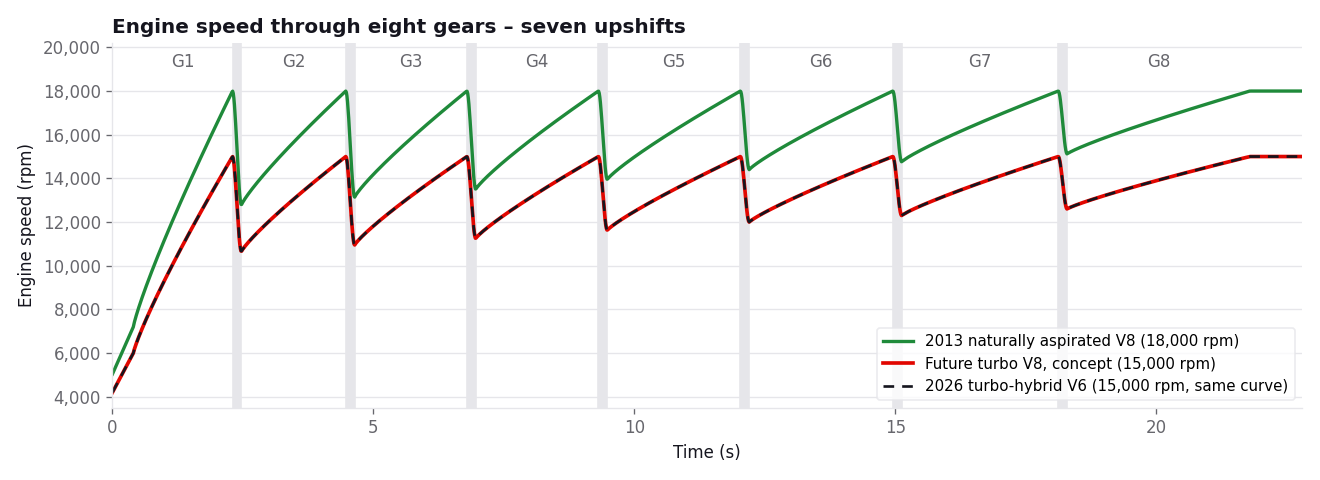
Engine speed through the eight gears in the simulation. The 2013 engine reaches 18,000 rpm; the two turbo engines are capped at 15,000.
What is assumed, and what is not
The 2026 V6 is modelled with the regulation's 15,000 rpm limit and eight forward gears, with illustrative ratios and shift points – not telemetry from a real lap. The future V8 is a concept: a 3.0-litre turbo has been discussed publicly, but displacement, rev limit, hybrid share and the start date are not decided, so its track is a guess built on those discussions. The 2013 V8 had seven forward gears; the simulation gives it an eighth so that all three run the same profile, and its 18,000 rpm limit is the one the period regulations imposed.
Two things the synthesis cannot capture: the exhaust geometry, which shaped the real engines' character as much as the firing rate, and the energy-recovery system, which in 2026 shifts a large share of propulsion to an electric motor that makes no noise at all. A 50/50 hybrid V8 would still spend part of every lap sounding like a V8 at part throttle.
Why it matters beyond nostalgia
The sound is a by-product of where the energy goes. A naturally aspirated engine at 18,000 rpm throws a large share of its fuel out of the exhaust as heat and noise; a turbocharged hybrid recovers it. The 2026 power units are the most efficient racing engines ever built, and the quietest for the same reason. Any future rule that brings the noise back is, by the same arithmetic, choosing to recover less – and that is a decision about what Formula 1 is for, not only about engines.
Sources: FIA 2026 Power Unit Technical Regulations (rev limit, displacement, electric share); FIA 2013 Technical Regulations (2.4 L V8, 18,000 rpm, seven gears); public statements on a 2030–31 V8 by the FIA and F1 during 2026. Audio synthesised by F1 Strategy; firing frequency = rpm × cylinders / 120.